
Body Image Therapy: LCSW vs. Certified Coach - Who to Book
When you search for body image therapy, you will find two very different paths: a licensed clinician or a certified coach. Both promise support, both use welcoming language about self-acceptance, and both show up in the same search results.
If you are unsure which one actually treats your specific concern, you risk months of the wrong kind of help. This article breaks down exactly what separates the two, so you know which one to book first.
A licensed LCSW can diagnose and treat eating disorders and clinical body image concerns, while a certified coach offers general encouragement and accountability but cannot treat a diagnosable condition.
Body Image Therapy Compared - LCSW Therapist vs. Certified Coach
Body image therapy looks similar on the surface, but the credentials behind it are not interchangeable.
An LCSW completes a master's degree in social work, at least 3,000 hours of supervised clinical experience over 104 weeks, and a state licensing exam before treating clients.
A certified coach typically completes a shorter certification program with no state licensing requirement and no legal authority to diagnose a mental health condition.
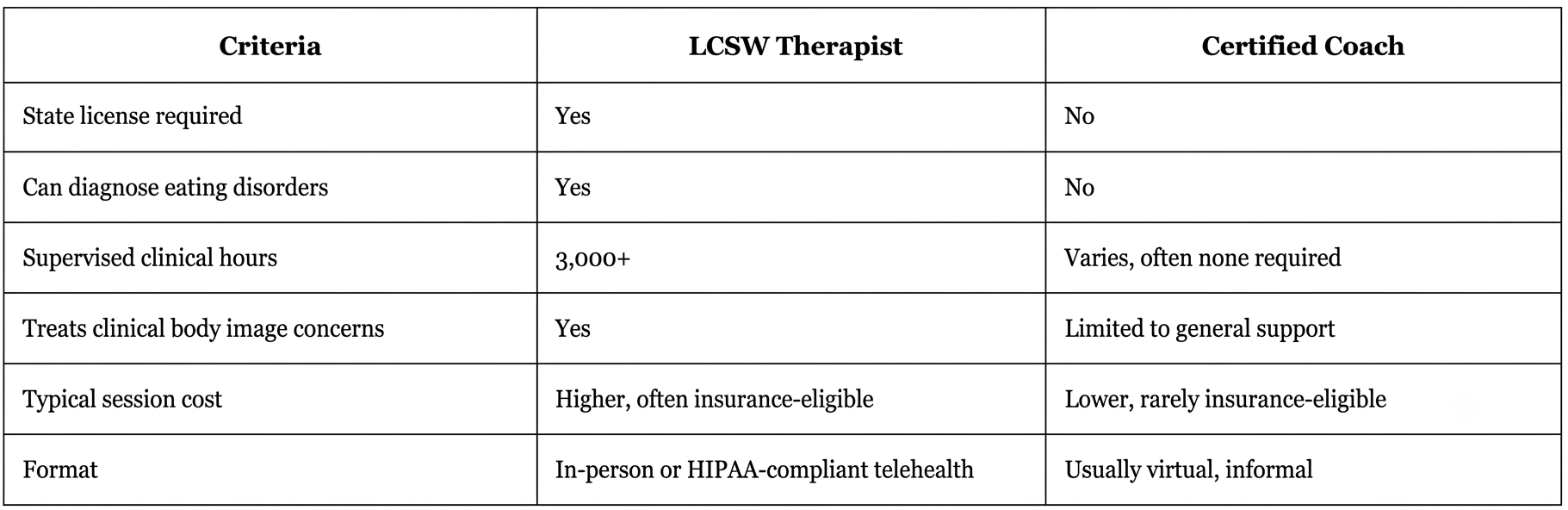
What Body Image Therapy From an LCSW Practice Does Best
Body image therapy delivered by a licensed clinician goes beyond encouragement.
It treats the root causes of self-criticism, emotional eating, and disordered eating patterns rather than managing symptoms on the surface. Body Image 360 is built around this exact model, led by Susan K. Ward, LCSW, who brings more than 25 years of specialized experience in eating disorder treatment.
Clients get a licensed professional who is legally and clinically equipped to handle both diagnosable conditions and everyday body image concerns, not just general motivation.
The National Eating Disorders Association reports that nearly 9 percent of the US population, or 31 million Americans, will have an eating disorder in their lifetime. That scale of need is exactly why licensure matters when choosing body image therapy support.
A licensed clinician is trained to check for underlying disordered eating patterns before assuming a concern is purely about confidence, a distinction that shapes the entire treatment plan.
Clinical Licensure Behind Body Image 360's Approach
Susan Ward's LCSW credential means every session is grounded in recognized clinical standards, not informal coaching techniques. Before choosing a provider, ask directly about their clinical license and how many years of specialized experience they have with body image and eating concerns.
That question alone eliminates most unlicensed options from consideration.
Founder-Developed Method: Movement, Visualization, Positive Psychology
Body Image 360 combines body awareness, movement, visualization, and positive psychology into a single method developed by Susan Ward herself.
This structured approach targets the emotional root of body dissatisfaction rather than offering surface-level tips, setting it apart from generic coaching frameworks built around motivation alone.
A Safe, Judgment-Free Space for Every Concern
Whether a client has a formally diagnosed eating disorder or simply struggles with self-criticism, Body Image 360 provides a safe, supportive space without shame, guilt, or unrealistic expectations.
Sessions take place through a HIPAA-compliant teletherapy platform for virtual clients, keeping sensitive conversations protected regardless of location.
What a Certified Coach Offers
A certified coach typically provides accountability, motivation, and general lifestyle guidance around body confidence and habit-building. Coaching programs vary widely in structure and rarely require a state license, clinical exam, or supervised practicum hours.
This format can suit someone with mild, non-clinical goals, but it is not equipped to treat a diagnosed eating disorder or a deeper psychological pattern tied to body image.
Body Image Therapy: The Key Differences That Matter
The gap between these two options comes down to legal scope, training depth, and what happens when a concern turns out to be more serious than expected.
Scope of Practice
Yes, a coach can offer encouragement and structure, but that support usually stops at the edge of a diagnosable condition.
CDC surveillance data shows emergency department visits for eating disorders among adolescent females nearly doubled during 2020 and 2021 compared with 2019, underscoring how quickly an unaddressed concern can escalate.
A licensed clinician is trained to identify and treat that risk early. A coach is not licensed to do so.
The Scope-of-Practice Filter Most Guides Skip
Most articles compare therapists and coaches by listing features side by side, but few explain what licensure actually permits a provider to do versus what a certification does not.
An LCSW is legally authorized to diagnose and treat mental health conditions, including eating disorders and body dysmorphic patterns.
The National Institute of Mental Health confirms that psychotherapy is a core recommended treatment for eating disorders, a treatment only a licensed provider can deliver.
This federal guidance reflects the same distinction between licensed therapists and certified coaches explained throughout this guide.
A certified coach is not licensed to diagnose anything, no matter how experienced they sound in a bio. If your concern includes emotional eating, a history of disordered eating, or persistent self-criticism that affects daily life, book the LCSW.
If your goal is general motivation with no clinical history involved, a coach may be enough, but confirm that boundary before you commit.
Which Body Image Therapy Option Is Best for You?
Best for a certified coach: buyers with mild, non-clinical body confidence goals and no history of disordered eating who want light accountability.
Best for Body Image 360 (LCSW): buyers navigating emotional eating, self-esteem struggles, or a diagnosable eating disorder history who want licensed, evidence-informed care in a judgment-free space.
Frequently Asked Questions About Body Image Therapy
1. Can a certified coach treat an eating disorder?
No. A certified coach is not licensed to diagnose or treat an eating disorder. Only a licensed clinician, such as an LCSW, is legally authorized to provide that level of care. If you suspect a diagnosable condition, book a licensed provider first.
2. How much does body image therapy with an LCSW cost?
Pricing varies by session type and location, and licensed sessions are often insurance-eligible, unlike most coaching packages. Contact the provider directly for current rates and to confirm insurance compatibility.
3. Is Body Image 360 available outside San Diego?
Yes. Virtual coaching and online programs are available across the United States, Canada, and other English-speaking regions through a HIPAA-compliant teletherapy platform, in addition to in-person sessions in San Diego, CA.
4. What happens during a free discovery appointment?
The 15-minute discovery appointment with Susan Ward, LCSW, gives you a chance to describe your concerns and ask about her approach before committing to ongoing sessions. It is a low-pressure first step, not a full therapy session.
5. Do I need a diagnosis before booking body image therapy?
No. Body image therapy supports both diagnosed conditions and general struggles with self-criticism or body dissatisfaction. A licensed provider can assess your situation during your first session.
Conclusion
Body image therapy works best when the provider's credentials match the depth of your concern. If emotional eating, self-esteem struggles, or a history of disordered eating are part of your story, a licensed clinician gives you legal, clinical protection a coach cannot offer.
Book your free discovery appointment with Susan Ward, LCSW, today and find out whether Body Image 360's approach is the right fit for you.


