
Online Weight-Loss Coaching vs. Traditional Dieting Programs: Which One Actually Works Long-Term?
When you search for the best way to lose weight, you get dozens of conflicting answers. Every program promises results, but not all are designed for long-term success. If you have tried dieting before and found yourself back where you started, frustrated and unsure what went wrong, this comparison is for you.
Online weight-loss coaching and traditional dieting differ in method, professional depth, and, most critically, in what each approach is designed to do. This article breaks down those differences so you can decide with confidence.
Quick Comparison: Online Weight-Loss Coaching vs. Traditional Dieting
Online weight-loss coaching and traditional dieting both target weight reduction, but they differ fundamentally in scope, professional involvement, and what happens after the first results appear.
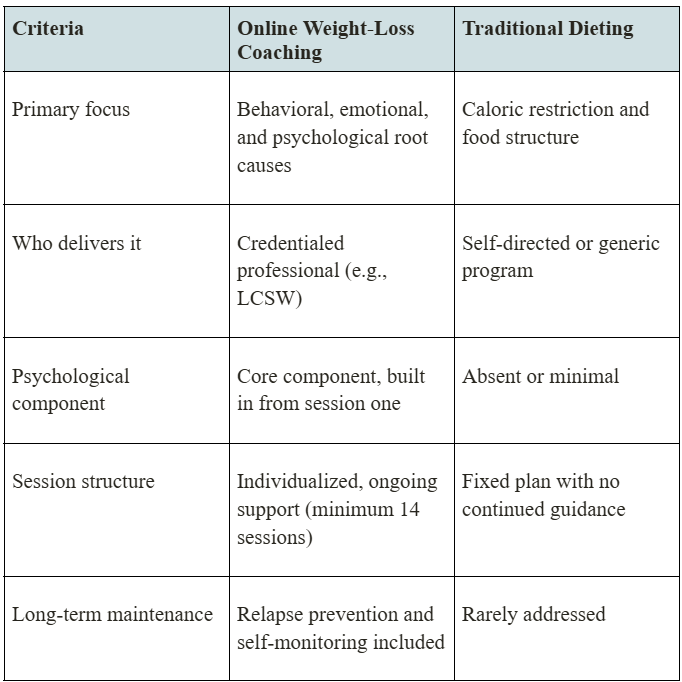
The criteria above reflect the standards that clinical research uses to measure weight management success, not marketing claims.
What Online Weight-Loss Coaching Actually Involves
Online weight-loss coaching goes beyond meal guidance. It targets the behavioral, emotional, and psychological patterns that determine whether your results last beyond the first few months.
Online weight-loss coaching is a professionally guided program that addresses the behavioral and emotional factors behind weight gain. Led by a credentialed professional such as an LCSW, it includes goal-setting, self-monitoring, problem-solving, social support, and relapse prevention.
1. The Biological Reason Dieting Alone Fails
Most people assume that losing weight through caloric restriction will hold if they stay disciplined enough. The biology disagrees.
According to the National Institute of Diabetes and Digestive and Kidney Diseases (NIDDK), as people lose weight through caloric restriction, appetite and calorie drive increase proportionately. The body's feedback system works harder to restore what it has lost.
The longer a restrictive diet continues, the stronger the body's drive to regain lost weight becomes. When eating concerns go without professional, structured care, individuals stay trapped in cycles of self-criticism and self-doubt that are far more likely to persist than resolve on their own.
2. What the U.S. Clinical Standard for Weight Management Requires
Effective weight management requires more than a meal plan.
The NIDDK's Behavioral Weight Loss Interventions guide (2025) confirms that the U.S. Preventive Services Task Force (USPSTF) recommends intensive, multicomponent behavioral interventions as the clinical standard for adult weight management.
These programs require a minimum of 14 structured sessions over six months, covering goal-setting, self-monitoring, problem-solving, social support, and relapse prevention.
Qualified professionals deliver care through evidence-informed methods combining body awareness, movement, visualization, and positive psychology. When sessions run virtually, they take place on a HIPAA-compliant teletherapy platform.
The standard is individualized care prioritizing mental and emotional well-being, not a program built around a number on a scale.
How Body Image 360's Online Weight-Loss Coaching Works
Body Image 360’s online weight-loss coaching combines licensed clinical therapy with a founder-developed method that works on your inner psychological relationship with food, your body, and your self-worth. This is not a diet plan. It is a structured path to lasting change.
Unlike traditional weight loss programs that focus solely on dieting and scale numbers, Body Image 360 prioritizes mental and emotional well-being.
Led by Susan K. Ward, LCSW, with over 25 years of specialized experience in eating disorder treatment, it blends body awareness, movement, visualization, and positive psychology into one structured coaching model.
A Licensed Therapist, Not a Diet Program
The difference between working with Body Image 360 and following a diet program starts with who is guiding you.
Susan K. Ward holds an LCSW credential with over 25 years of specialized experience in eating disorder treatment and body image counseling.
Sessions run through a HIPAA-compliant teletherapy platform, making credentialed support accessible across the United States, Canada, and other English-speaking regions. Your self-worth is not defined by a number on a scale, and every element of the Body Image 360 approach is built around that principle.
The Key Differences That Determine Long-Term Results in Weight Loss Coaching
The gap between short-term and long-term results comes down to whether a program reaches the emotional layer where most weight struggles actually live.
What Happens After the First Results
The scale may move in the first weeks of a diet. What happens in month three or month six is where the real picture emerges.
According to CDC NCHS Data Brief No. 508 (September 2024), adult obesity prevalence in the United States was 40.3% during August 2021 through August 2023, with women at 41.3%. New data from the CDC (October 2024) confirms that in 23 U.S. states, more than 1 in 3 adults currently lives with obesity.
These numbers reflect the gap between short-term restriction and long-term behavioral change. Without behavioral and psychological support, the body's own feedback system works against restriction as weight loss continues.
Frequently Asked Questions
Q1. Does online weight-loss coaching work better than dieting?
For people dealing with emotional eating, body image concerns, or a history of weight cycling, structured coaching consistently outperforms calorie restriction alone.
The NIDDK (2025) confirms that the USPSTF-recommended standard is a multicomponent behavioral intervention spanning a minimum of 14 individualized sessions. Dieting addresses food intake. Coaching addresses the patterns that determine whether change holds.
Q2. Why do I keep regaining weight after every diet?
According to the NIDDK, as the body loses weight through caloric restriction, appetite and calorie drive increase proportionately, creating a biological pull toward regain that restriction alone cannot counteract. Without behavioral and psychological support built into the program, that pull wins eventually.
Q3. What does an online weight-loss coach do that a diet plan doesn't?
A qualified online weight-loss coach delivers individualized, structured care through evidence-informed methods combining body awareness, movement, visualization, and positive psychology. Qualified professionals hold a clinical license such as an LCSW credential. That depth of care is what a meal plan is not designed to provide.
Q4. Is virtual weight-loss coaching as effective as in-person sessions?
Yes, when delivered through a credentialed program on a HIPAA-compliant platform. The NIDDK confirms that multicomponent behavioral interventions work effectively in-person, by phone, or online.
Body Image 360 conducts all virtual sessions through a HIPAA-compliant platform, making LCSW-led support accessible across the U.S., Canada, and other English-speaking regions.
Q5. How do I get started with Body Image 360?
The first step is a 15-minute individual discovery appointment with Susan K. Ward, LCSW, a judgment-free conversation to help you decide whether the fit feels right. Appointments run Monday through Friday. Visit bodyimage360.com to book your session.
Your Next Step Starts With One Honest Conversation
Online weight-loss coaching works not because it replaces discipline, but because it addresses the layer that discipline alone cannot reach. The psychological patterns, the emotional relationship with food, and the self-worth that diet programs never touch are exactly where Body Image 360 begins.
Lasting change begins when you address both the emotional and behavioral factors behind weight struggles.
Book your free 15-minute discovery appointment with Susan K. Ward, LCSW, at Body Image 360 and take the first step toward a relationship with your body built on self-acceptance, not the scale. Visit bodyimage360.com to schedule today.


