
Virtual Weight Loss Coach vs. In-Person Therapy: Which Is Better For Emotional Eating?
When you search for support with emotional eating, you get dozens of answers. Whether you are considering a virtual weight loss coach, a local therapist, or an online program, each option claims to offer the solution. This article shows what actually matters when comparing your choices.
Emotional eating runs deeper than food habits. It connects to cycles of self-criticism, body dissatisfaction, and self-worth that no meal plan can fix. The real question is whether the person delivering it holds the right credential and uses a guided method that addresses the root.
A qualified virtual weight loss coach using a licensed, evidence-informed method can reach the psychological root of emotional eating as effectively as in-person therapy. For people outside San Diego, virtual support can make specialized care more accessible.
Virtual Weight Loss Coaching vs. In-Person Therapy: A Quick Comparison
Virtual weight loss coaching and in-person therapy differ less in outcomes and more in credential, method, and geographic access. Those differences shape everything.
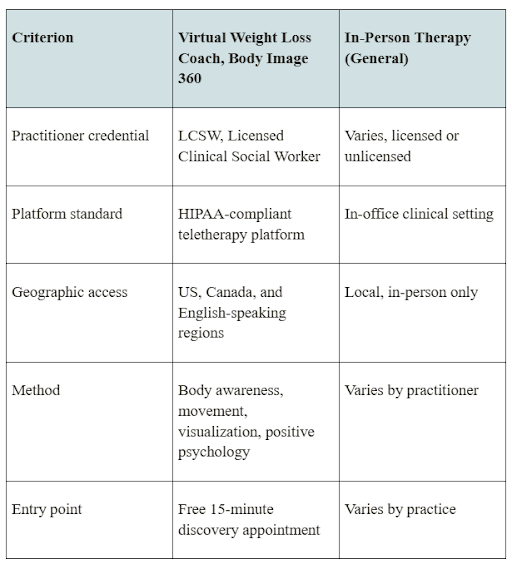
Body image counseling and weight loss coaching are mental and emotional health services. Qualified professionals in this field are expected to hold the appropriate clinical license for their scope of practice and to deliver care through evidence-informed methods, not generic dieting advice.
What a Virtual Weight Loss Coach With an LCSW Actually Delivers
A virtual weight loss coach backed by an LCSW credential targets the psychological patterns, body image beliefs, and emotional cycles that drive eating habits, not the habits alone.
At Body Image 360, sessions focus on body awareness, cognitive reframing, and self-reflection to create lasting change.
What You Get in Each Session
Licensed LCSW support with over 25 years of specialized eating disorder experience.
One-on-one sessions using movement therapy, cognitive reframing, and self-reflection.
Access across the US, Canada, and other English-speaking regions through a HIPAA-compliant teletherapy platform.
A free 15-minute discovery appointment with Susan K. Ward, LCSW.
1. The Body Image 360 Method
Susan K. Ward developed a method that blends body awareness, dance movement, visualization, and positive psychology. The Stages to Self-Acceptance Program moves you through six phases: letting go, acknowledgement, setting limits, empowerment, acceptance, and self-respect.
Each phase shifts your relationship with your body from self-criticism toward self-acceptance. The standard is individualized care that prioritizes mental and emotional well-being, not a one-size-fits-all program centered on the scale.
2. Why the HIPAA-Compliant Platform Matters for Sensitive Disclosures
Virtual sessions at Body Image 360 are conducted through a HIPAA-compliant teletherapy platform. The California Board of Behavioral Sciences confirms that LCSW licensure requires a master's degree in social work from an accredited program, a minimum of 3,000 supervised clinical hours, and passing the ASWB Clinical Exam.
The HHS Telehealth guidance on licensing across state lines confirms licensed practitioners must hold valid jurisdiction licensure to deliver telehealth. That standard filters out unlicensed programs.
What In-Person Therapy Offers and Its Honest Limits
Virtual weight loss coaching and in-person therapy can both be effective, but in-person access carries limits that directly affect many buyers searching for support online.
In-person therapy offers physical presence, which some buyers genuinely value. Yes, face-to-face contact is a real preference, but it only matters when the provider holds the right credentials and uses a method that addresses emotional eating at the root.
For buyers outside San Diego or in areas without access to a licensed clinician using an evidence-informed body image approach, in-person is not always a practical option.
A 2025 JMIR Mental Health review found that telemedicine can support eating disorder treatment by improving retention, reducing symptoms, and strengthening patient-clinician communication.
A 2025 study by the NIH found no significant differences in treatment outcomes between telehealth and in-person delivery. For buyers who need a credentialed clinician, virtual delivery is a sound choice.
1. What to Check Before You Choose Support
Before you choose a virtual weight loss coach or in-person therapist, ask:
Does the practitioner hold a clinical license such as an LCSW?
Does the method prioritize self-acceptance over dieting and numbers on a scale?
Do sessions take place in a safe, judgment-free space?
For virtual care, is the platform HIPAA-compliant?
Can you begin with a free consultation or short discovery appointment?
2. Why Emotional Eating Needs More Than a Change of Room
Emotional eating is rooted in cycles of self-criticism, body dissatisfaction, and disconnection from the body, not in the location of a session. What changes outcomes is the method, the license, and the clinical depth the practitioner brings.
The National Institute of Mental Health confirms that eating disorders are serious illnesses that can be life-threatening and that early professional intervention significantly improves outcomes.
Professional support can help address ongoing struggles with food, body image, and self-worth before they become more difficult to manage.
The right fit depends on your geographic access to a credentialed clinician and whether the practitioner's method addresses the psychological root of emotional eating.
3. Best suited to a virtual weight loss coach with Body Image 360
Women aged 16 to 60 across the US, Canada, or other English-speaking regions who want LCSW-led support for emotional eating and body image, delivered through a holistic method that prioritizes self-acceptance, and who want a free 15-minute discovery appointment with Susan K. Ward, LCSW.
Frequently Asked Questions
Q1. Can a virtual weight loss coach really help with emotional eating, or do I need to be seen in person?
A virtual weight loss coach who holds an LCSW credential and applies an evidence-informed method can address the psychological root of emotional eating without an in-person setting.
A 2025 systematic review in JMIR Mental Health found telemedicine showed promising results for eating disorder treatment, including reduced symptoms and improved retention, with no direct adverse effects reported.
A separate 2025 study by NIH found no significant outcome differences between telehealth and in-person treatment. Credential and method matter more than format
Q2. What credentials should a virtual weight loss coach have for body image and eating concerns?
Look for a licensed clinical social worker, or LCSW, a credential that requires a master's degree in social work, 3,000 supervised clinical hours, and passing the ASWB Clinical Exam, as confirmed by the California Board of Behavioral Sciences. Virtual sessions should use a HIPAA-compliant platform. The
HHS Telehealth licensing guidance confirms licensed practitioners must hold valid jurisdiction licensure to deliver telehealth across state lines, so always verify the credentials before booking.
Q3. What is the difference between a virtual weight loss coach and an online therapist?
A virtual weight loss coach addresses the behavioral, emotional, and mindset patterns connected to food, body image, and self-worth using guided techniques. A licensed online therapist holds a clinical credential such as an LCSW and provides professional psychotherapy within a regulated clinical framework.
Body Image 360 offers both weight loss coaching and professional psychotherapy under one LCSW-led practice, which gives you the depth of clinical therapy with the personalized focus of one-on-one coaching.
Q4. How do I get started with Body Image 360's virtual coaching?
Body Image 360 offers a free 15-minute Individual Discovery Appointment with Susan K. Ward, LCSW. This first step lets you share what you are navigating and decide whether the fit feels right. Book your discovery call directly through the Body Image 360 website at bodyimage360.com.
Your Next Step Starts With One Honest Conversation
The format matters far less than the credential and method behind it. What breaks the emotional eating cycle is a licensed approach that treats the root, your relationship with your body, and your self-worth.
Body Image 360 delivers that support virtually through a HIPAA-compliant platform, led by Susan K. Ward, LCSW, with over 25 years of specialized experience and a method built around body awareness, movement, visualization, and positive psychology. You were never broken. The work starts from the inside.
Book your free 15-minute discovery appointment with Susan K. Ward, LCSW, at bodyimage360.com, the best virtual weight-loss coach, and take the first step toward healing your relationship with food on your own terms.


